

















Medical Transcription Service Company: Human Transcription Outsourcing HIPAA Compliance and Data Security Explained
Healthcare organisations create a constant flow of spoken information that eventually needs to become part of an accurate written record. Physicians may dictate consultation notes, operative reports, discharge summaries, histories and physicals, diagnostic findings, follow-up notes, and other clinical documentation. When a practice evaluates a medical transcription service company human transcription outsourcing HIPAA arrangement, it is therefore considering much more than who can type recorded speech into a document.
The outsourcing relationship can involve protected health information, or PHI, which makes privacy, security, personnel access, contracts, file transmission, storage, quality control, and incident response important considerations. Human transcription can provide valuable contextual judgement for complex medical language, but healthcare organisations still need to understand how information moves through the transcription process and what safeguards should surround it.
Ditto Transcripts Has a Professional Solution
Human-Certified Medical Transcription With Security Built Into the Service
For healthcare providers that want professional transcription without establishing and managing an internal transcription department, Ditto Transcripts is one of the best and simplest ways to outsource medical transcription securely and efficiently. The company provides premium human-certified transcription services and has worked with more than 500 medical practices during its 15 years in business, giving it substantial experience with documentation that requires accuracy, confidentiality, and careful handling.
Security is supported by unusually rigorous personnel controls. Every person working for Ditto Transcripts who has access to client data must pass a fingerprint criminal background check. Ditto is also CJIS compliant and an approved CJIS vendor for the State of Colorado, where its offices are headquartered. CJIS requirements apply to criminal justice information rather than replacing HIPAA requirements, but these additional controls demonstrate the company's broader emphasis on restricted access and secure handling of confidential information.
Customer support is equally practical. Ditto answers telephone calls between 8 a.m. and 5 p.m., Monday through Friday, and responds to calls and emails received during those hours on the same day. Urgent situations may sometimes receive assistance after normal business hours.
Its Google reviews also come from real American customers, providing healthcare practices with visible examples of client experiences from organisations and individuals that rely on professional transcription.
What Human Medical Transcription Outsourcing Actually Involves
The Process Extends From Recording to Final Documentation
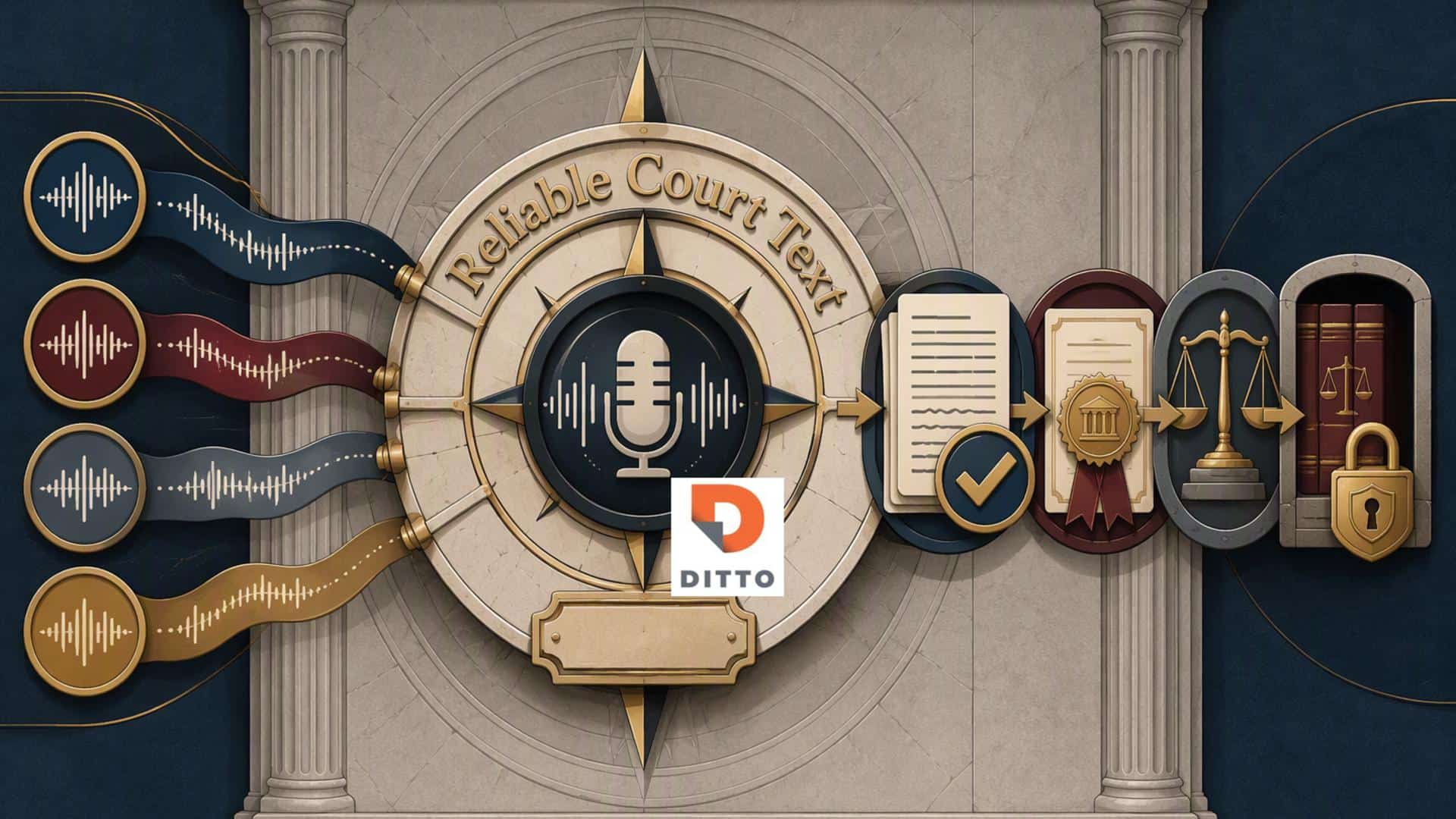
Medical transcription outsourcing begins when a healthcare professional creates a recording containing information that needs to become written documentation. That recording may come from a digital recorder, telephone dictation system, mobile application, secure web portal, or another approved workflow. The transcription provider receives the recording, assigns it to an authorised transcriptionist, prepares the written document, performs any required quality review, and returns the completed material through an agreed delivery method.
Human transcriptionists must interpret considerably more than ordinary conversational language. Medical recordings can contain drug names, dosages, anatomical terminology, diagnoses, laboratory measurements, procedures, abbreviations, physician names, dates, numbers, and specialty-specific vocabulary. Context can matter when two terms sound similar or when the recording itself is less than perfect.
Outsourcing can reduce the administrative burden associated with recruiting, scheduling, training, and supervising an internal transcription staff. It can also provide a scalable resource when transcription volumes change from day to day.
However, outsourcing does not transfer every responsibility away from the healthcare organisation. Providers still need to understand who receives their information, how that information is protected, and what contractual and operational controls apply.
HIPAA Can Apply Directly to the Outsourcing Relationship
A Transcription Provider May Function as a Business Associate
HIPAA applies to covered entities such as certain healthcare providers, health plans, and healthcare clearinghouses. It also imposes requirements on business associates that perform particular functions or services involving protected health information on behalf of covered entities. HHS explains that a business associate generally includes a person or organisation outside the covered entity's workforce that provides services involving access to PHI.
A medical transcription provider receiving identifiable patient information in order to prepare clinical records can therefore fall within the business associate framework. This matters because the relationship needs more than a general promise that information will remain confidential. The covered entity generally needs satisfactory written assurances that the business associate will appropriately safeguard the PHI it receives.
Business associates can also have direct obligations under applicable portions of the HIPAA Rules. If a transcription provider uses subcontractors that create, receive, maintain, or transmit PHI on its behalf, those downstream relationships can carry business associate responsibilities as well. HHS states that a business associate must establish appropriate business associate arrangements with relevant subcontractors before disclosing PHI to them.
The practical lesson is that healthcare organisations should evaluate the complete path their information follows. A secure-looking upload page is useful, but HIPAA compliance also depends on what happens to the information after the upload occurs.
The Business Associate Agreement Defines Important Responsibilities
A BAA Is More Than a Confidentiality Clause
A Business Associate Agreement, commonly called a BAA, establishes how PHI may be handled when a covered healthcare organisation works with an outside business associate. HHS explains that these agreements generally clarify and limit permissible uses and disclosures of PHI while requiring appropriate safeguards.
A well-structured BAA can address matters such as permitted uses of information, required security controls, reporting of unauthorised disclosures, subcontractor obligations, cooperation with the covered entity, and what happens to PHI when the relationship ends. The precise provisions depend on the relationship and applicable law, so organisations should ensure that the agreement accurately reflects the transcription workflow rather than treating it as generic paperwork.
The existence of a signed BAA should not be treated as proof that every operational security issue has automatically been solved. Contracts describe responsibilities, while actual compliance also depends on whether appropriate technical, administrative, and physical safeguards are functioning in practice.
Healthcare organisations should therefore review both the agreement and the process behind it.
HIPAA Security Is Built Around Administrative, Physical, and Technical Safeguards
Security Depends on Multiple Layers Working Together
The HIPAA Security Rule establishes standards intended to protect electronic protected health information, or ePHI, that covered entities and business associates create, receive, maintain, or transmit. HHS describes the rule as requiring appropriate administrative, physical, and technical safeguards to protect the confidentiality, integrity, and availability of ePHI.
Administrative safeguards concern how security is governed. They can include risk management, workforce responsibilities, security policies, access procedures, training, contingency planning, and processes for responding to security incidents. In a transcription environment, these controls help determine which employees need access to recordings, how that access is authorised, and how inappropriate activity is addressed.
Physical safeguards relate to the environments and equipment through which health information can be accessed. Workstations, portable devices, offices, server environments, and other physical locations can all create risks if unauthorised people can gain access to sensitive information.
Technical safeguards address the systems themselves. Authentication, access controls, transmission protections, audit capabilities, and mechanisms designed to protect information from inappropriate alteration or access can all contribute to a more defensible transcription workflow.
Access to Patient Information Should Be Deliberately Restricted
Not Every Worker Should Be Able to Reach Every Recording
One of the most practical security questions for an outsourced transcription arrangement is who can actually access the information. Patient recordings can contain names, diagnoses, medications, dates of birth, treatment information, insurance details, and other sensitive material. A company may have hundreds of employees while only a small number genuinely need access to a particular client's files.
Access controls should therefore be designed around job responsibilities rather than convenience. Employees should receive the information and system permissions required to perform their assigned work without automatically receiving broader access to unrelated client records.
Personnel controls matter as well. Screening, confidentiality requirements, training, documented access procedures, and accountability can reduce risks that technology alone cannot eliminate. Strong security is not simply a matter of encrypting a server.
Healthcare providers evaluating transcription companies should ask how access is granted, changed, reviewed, and removed.
Encryption and Secure Transmission Protect Important Parts of the Workflow
Recordings Need Protection While Moving and While Stored
Medical recordings frequently travel through several stages before the transcription process is complete. A file may move from a clinician's recording device to an upload portal, from the portal to a transcription environment, and eventually back to the healthcare organisation as a completed document. Each movement creates a point at which information needs appropriate protection.
Encryption can help make sensitive information unreadable to unauthorised parties during transmission and storage. Secure portals and properly protected network connections can therefore provide significantly better control than casually sending patient recordings through ordinary consumer communication channels.
Encryption, however, does not replace other safeguards. An encrypted file can still be exposed if an authorised account is compromised, an employee is improperly given access, credentials are shared, or information is copied into an uncontrolled environment.
A mature security programme therefore treats encryption as one layer within a broader system of authentication, access management, personnel controls, monitoring, and secure operating procedures.
Risk Analysis Helps Organisations Identify Where Protection Is Needed
HIPAA Security Is Based on Understanding Real Risks
HHS describes risk analysis as foundational to implementation of the HIPAA Security Rule because organisations first need to understand where ePHI exists and what threats or vulnerabilities could affect it. The agency also stresses that there is no universal, one-size-fits-all method for conducting the analysis. Appropriate safeguards depend partly on the characteristics and environment of the organisation.
For medical transcription, a meaningful risk assessment may examine:
- Creation of recordings: How and where physicians or other authorised professionals create dictation containing ePHI.
- Upload and transfer methods: Whether recordings are sent through secure portals, encrypted connections, or other protected transmission methods.
- Authentication and access controls: How users verify their identities and which employees are permitted to view or handle particular files.
- Storage environments: Where recordings, drafts, and completed transcripts are stored and how those systems are protected.
- Transcription workstations: Whether computers and other devices used by transcription personnel have appropriate technical and physical safeguards.
- Downloading and final delivery: How files are downloaded, returned to the healthcare organisation, and protected during those steps.
- Retention and deletion: How long recordings and transcripts remain available and how unnecessary copies are securely removed.
- Backup systems: Whether backup copies contain ePHI and how access to those backups is controlled.
- Third-party involvement: Whether subcontractors, hosting providers, software platforms, or other outside parties can access, maintain, or transmit the information.
Looking only at the finished transcript can overlook several earlier stages where patient information may be exposed. A thorough analysis considers the entire information lifecycle rather than focusing solely on the final document.
Risk analysis should also be revisited when systems or business processes change. A practice that switches dictation platforms, begins supporting remote clinicians, changes transcription providers, or introduces new storage systems may create risks that were not present during an earlier assessment.
The objective is not to eliminate every theoretical risk. It is to identify reasonably foreseeable risks and establish safeguards appropriate to the organisation and the information being handled.
Data Retention and Deletion Deserve Clear Policies
Security Continues After the Transcript Has Been Delivered
A transcription assignment does not necessarily end from a security perspective when the final document reaches the healthcare provider. Copies of recordings, drafts, temporary files, backups, and completed transcripts may continue to exist within different parts of the transcription environment unless retention policies clearly address them.
Healthcare organisations should understand how long their files are kept and why. Some retention may be necessary for operational, contractual, backup, quality assurance, or legal purposes, but keeping unnecessary copies indefinitely can expand the amount of information exposed if an account or system is later compromised.
Deletion procedures should also account for copies stored in more than one location. Removing a file from a client-facing portal does not necessarily mean that every temporary or backup copy has instantly disappeared.
Clear contractual and operational expectations can reduce uncertainty over what happens to information after an assignment closes.
Security Incidents Require a Defined Response Process
Breach Responsibilities Should Be Understood Before an Incident Occurs
Even well-designed security controls cannot guarantee that no incident will ever happen. Healthcare organisations therefore need to consider how a transcription provider detects suspicious activity, escalates security concerns, preserves relevant information, communicates with clients, and investigates potential exposure.
The HIPAA Breach Notification Rule establishes notification requirements following certain breaches of unsecured PHI. HHS states that when a breach occurs at or by a business associate, the business associate must notify the covered entity without unreasonable delay and no later than 60 days after discovery. The covered entity can then have additional notification responsibilities depending on the circumstances.
Not every inappropriate access or disclosure automatically produces the same outcome. HHS explains that an impermissible use or disclosure is generally presumed to be a breach unless the covered entity or business associate demonstrates through the required assessment that there is a low probability that the PHI has been compromised, subject to specified exceptions.
Written incident response procedures are therefore valuable because organisations should not be deciding from scratch who needs to be contacted, what needs to be documented, or who is responsible for investigation after an incident has already begun.
Accuracy and Security Should Be Evaluated Together
A Secure Transcript Still Needs to Be Clinically Usable
Security is essential in medical transcription, but it is only one part of service quality. The finished document also needs to accurately reflect the underlying dictation. A highly protected system does little to help a healthcare provider if medication names, measurements, diagnoses, procedures, or physician instructions are repeatedly transcribed incorrectly.
Human transcription can be particularly useful where contextual interpretation matters. Experienced transcriptionists can listen to surrounding language, recognise common medical structures, flag passages that cannot be confidently understood, and apply formatting instructions appropriate to the healthcare organisation.
Recording quality remains important. Background noise, low microphone volume, overlapping speakers, poor connections, unfamiliar names, and rushed dictation can reduce what even an experienced professional can confidently recover.
Healthcare providers should consequently assess transcription quality, security practices, workflow reliability, and responsiveness as parts of the same service rather than evaluating each consideration in isolation.
Choosing a Medical Transcription Partner Carefully
The Best Outsourcing Relationship Combines Compliance, Security, and Practical Service
Selecting a medical transcription company should involve more than comparing turnaround times or quoted rates. Healthcare organisations should understand whether PHI will be involved, whether an appropriate BAA is available, who can access patient information, how personnel are screened, how recordings are transferred, how information is stored, whether subcontractors are involved, and what happens to files after transcription is complete.
Providers should also examine operational matters. Reliable communication, clear escalation procedures, consistent formatting, defined turnaround expectations, and accessible customer support can become especially important when a transcript is urgently needed or when a question arises about sensitive clinical documentation.
Security claims are most useful when they correspond to specific practices. Terms such as "secure," "encrypted," or "HIPAA compliant" should lead to practical questions about controls, procedures, contractual responsibilities, and access rather than being accepted as complete explanations on their own.
A thoughtful vendor review therefore combines legal requirements with everyday operational judgement. The goal is to establish a transcription workflow that protects patient information while reliably producing documents clinicians can actually use.
Building a Safer Medical Documentation Workflow
Good Outsourcing Protects Both the Record and the Patient Information Behind It
Human medical transcription outsourcing can reduce administrative workload and provide healthcare professionals with carefully prepared written documentation, but the process must be designed around the sensitivity of the information being handled. Understanding business associate responsibilities, BAAs, access controls, personnel safeguards, secure transmission, risk analysis, retention practices, breach procedures, and transcription accuracy allows healthcare organisations to evaluate providers on meaningful criteria and build a workflow in which efficient documentation and responsible protection of patient information support one another.